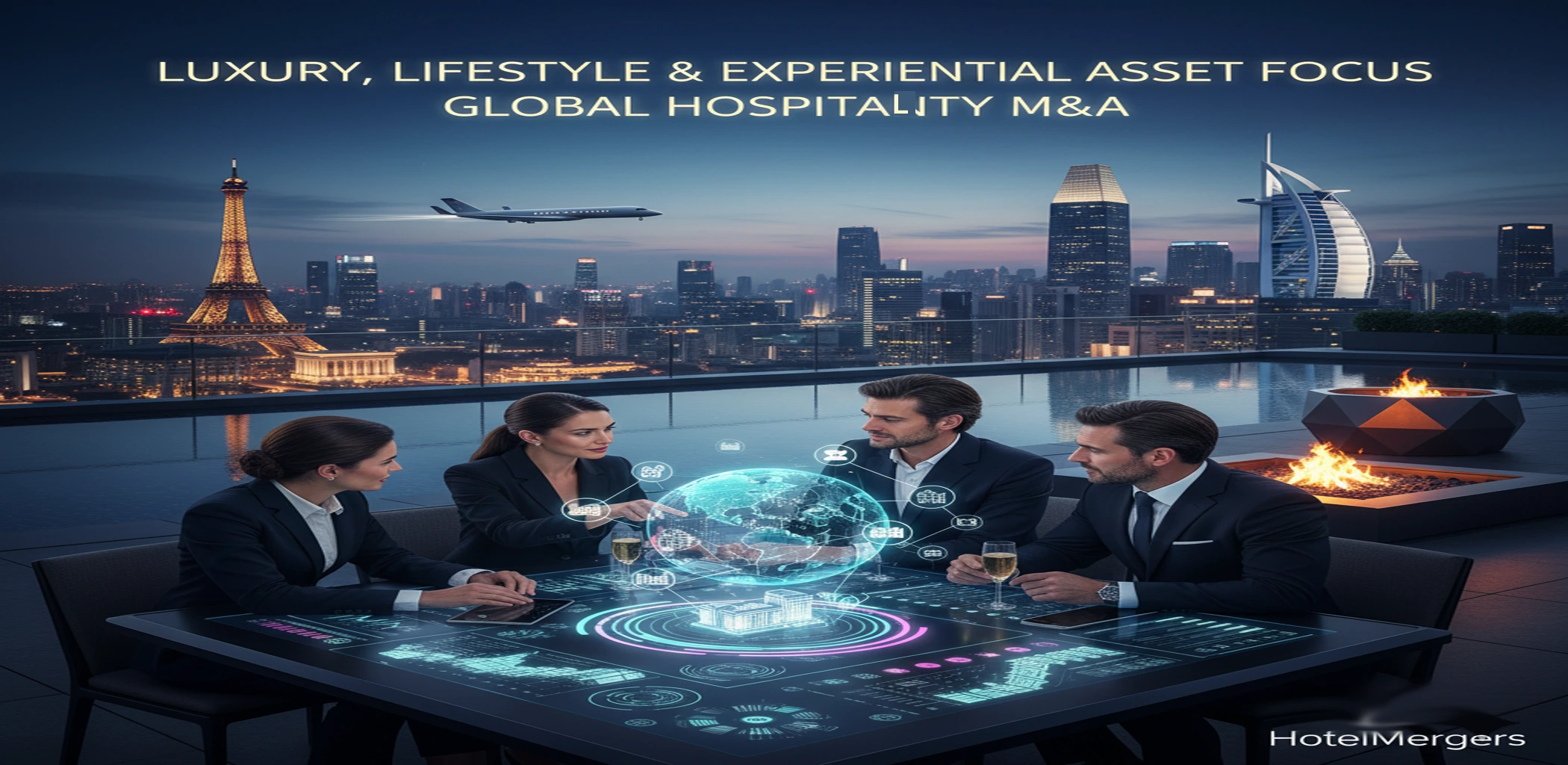
In the evolving world of global hospitality, luxury is no longer defined by marble floors or chandeliers—it’s measured by emotional resonance, cultural authenticity, and curated experience. As travelers become more discerning, the world’s largest hotel groups, private equity firms, and sovereign funds are transforming their acquisition strategies to align with this new paradigm: the rise of lifestyle and experiential hospitality assets.
Global M&A activity in the hospitality sector has entered a phase where “luxury” is synonymous with “differentiation.” Investors are moving away from standardized properties toward distinctive, story-driven, and experience-led brands. From wellness resorts in Costa Rica to boutique hotels in Kyoto, and from desert retreats in Saudi Arabia to culinary-focused lodges in Italy, experiential luxury has become the most coveted segment in M&A.
The result? A wave of targeted acquisitions reshaping the luxury landscape—where scale meets soul, and capital meets creativity.
1. The Strategic Pivot Toward Lifestyle and Experience
The shift toward lifestyle hospitality began as a niche movement in the 2000s, driven by traveler fatigue with generic hotel experiences. But in the 2020s, this evolution became mainstream strategy.
Millennial and Gen Z travelers, who together account for over 60% of global leisure travel spending, prioritize authenticity, community, and sustainability over opulence for its own sake. In response, M&A strategies evolved from asset-heavy to experience-heavy—focused on boutique, wellness, adventure, and cultural immersion brands that command emotional loyalty.
Global giants like Marriott, Accor, and Hyatt have reorganized their growth playbooks to prioritize lifestyle brands:
- Marriott’s Moxy and Edition
- Hyatt’s Alila, Thompson, and Miraval
- Accor’s Ennismore collective (The Hoxton, Mama Shelter, 25hours, SLS)
- Hilton’s Motto and Canopy
These acquisitions and brand partnerships illustrate a decisive trend: the luxury of the future is experiential, not ornamental.
2. The Economics of the Lifestyle Segment
Lifestyle and luxury hotels command higher average daily rates (ADR) and stronger RevPAR growth than traditional upscale brands, often outperforming the broader market by 15–30%. Their margins are sustained not by room volume, but by experience monetization—wellness programs, destination dining, art residencies, or community events.
From an M&A standpoint, such assets are prized for:
- Resilient demand among affluent travelers even in downturns.
- High brand loyalty and repeat visitation.
- Diversified revenue beyond accommodation.
Private equity firms recognize this resilience and have increased allocation toward experiential brands, particularly in leisure-focused geographies. According to KPMG’s 2025 Leisure Report, over 40% of new hospitality M&A activity now targets boutique, luxury, or lifestyle assets.
3. Case Studies in Experiential Acquisition
a. Hyatt’s Acquisition of Apple Leisure Group (ALG)
In 2021, Hyatt acquired ALG for $2.7 billion, gaining entry into the luxury all-inclusive and experiential wellness segment. The deal gave Hyatt access to over 100 high-end resorts across the Americas, integrating wellness, culinary, and leisure experiences under a single luxury umbrella.
b. Accor’s Ennismore Joint Venture
Accor’s merger with Ennismore in 2022 created one of the world’s largest lifestyle hospitality operators, bringing together 14 distinct brands rooted in experience-led storytelling. The transaction represented a blueprint for hybrid M&A models blending equity, brand management, and creative autonomy.
c. LVMH’s Expansion into Hospitality
LVMH, through Belmond and Cheval Blanc, continues to acquire luxury hotels and experiential travel brands aligning with its haute couture ethos. Its model integrates luxury travel with lifestyle retail—a cross-sector fusion defining the new frontier of experiential luxury.
4. Experiential Hospitality as an Investment Class
For institutional investors, experiential hospitality is emerging as a distinct asset class. Unlike traditional hotels, which rely on standardized operations and predictable occupancy, experiential assets trade on narrative-driven differentiation.
Funds such as KKR, BlackRock, and Brookfield have expanded their hospitality portfolios to include:
- Eco-lodges and safari resorts.
- Culinary travel brands.
- Mountain and wellness retreats.
- Adventure- and culture-based resorts.
Their M&A strategies emphasize story equity—the intangible value derived from a brand’s identity and connection with its audience. Investors now assess factors like brand “authenticity index,” ESG footprint, and community integration alongside financial metrics.
5. The Rise of Hybrid and All-Inclusive Luxury Models
The all-inclusive model, once synonymous with mid-market vacation resorts, has been redefined through luxury M&A. Brands such as ALG (Hyatt), Club Med (Fosun), and Sandals (Playa) have repositioned “inclusive” as “indulgent”—curated with Michelin-level dining, wellness programs, and bespoke cultural experiences.
Acquirers view such models as operationally efficient (predictable revenue per guest) and strategically scalable across leisure markets. The luxury all-inclusive segment now accounts for nearly 20% of new resort pipeline deals globally.
6. Wellness, Longevity, and the Health Economy
A defining driver of luxury M&A is the fusion of hospitality and wellness. The global wellness economy, valued at $5.6 trillion by the Global Wellness Institute, has become central to hospitality investment strategy.
Deals like Hyatt’s acquisition of Miraval Resorts, Accor’s partnership with Therme Group, and Aman’s expansion into wellness retreats show how M&A is now capturing the wellness continuum—combining physical rejuvenation, mindfulness, and longevity.
Wellness-led luxury delivers dual value:
- High-yield room pricing.
- Strong alignment with ESG and sustainability goals.
7. Sustainability as a Luxury Pillar
Modern luxury is inseparable from sustainability. Travelers increasingly equate responsible tourism with sophistication. Hence, acquisitions now focus on brands with proven eco-credentials—carbon neutrality, regenerative tourism practices, and community engagement.
Examples include:
- Six Senses (IHG)—a pioneer in sustainable luxury.
- Nihi Sumba (Indonesia)—renowned for community-based tourism.
- One&Only and Soneva—leaders in eco-luxury resort design.
Institutional investors are also incentivized by green-financing instruments, where ESG compliance enhances valuation and reduces cost of capital.
8. Regional Dynamics in Luxury & Lifestyle M&A
North America
The U.S. market focuses on luxury repositioning—acquiring iconic city properties and transforming them into experiential lifestyle hotels. Private equity groups like Blackstone and Host Hotels are leading adaptive-reuse investments, converting heritage buildings into boutique luxury assets.
Europe
Europe remains the heartbeat of luxury heritage. M&A activity centers on independent boutique hotels in France, Italy, and Spain. Family-owned icons are increasingly acquired by institutional capital seeking cultural credibility and steady yield.
Middle East
Saudi Arabia’s Vision 2030 and the UAE’s diversification agenda have turned the Gulf into the world’s fastest-growing luxury hospitality hub. Sovereign funds are acquiring global brands and integrating them into giga-projects like NEOM, Red Sea, and Qiddiya.
Asia-Pacific
Asia’s rising affluence is fueling demand for experiential luxury. Indian and Southeast Asian investors are acquiring resort brands to cater to outbound luxury travelers. Japan and Bali are seeing record inflows into boutique experiential resorts.
9. Cultural Authenticity as a Value Multiplier
Experiential assets thrive when they embody place and culture. Acquirers now prioritize properties with deep local storytelling, architecture rooted in vernacular tradition, and experiences that bridge global standards with indigenous authenticity.
Post-acquisition strategies often include partnerships with local artisans, chefs, and cultural institutions. For investors, cultural credibility enhances differentiation and justifies premium pricing, turning authenticity into a tangible financial advantage.
10. The Fusion of Hospitality, Retail, and Design
Another defining M&A trend is the convergence of hospitality with fashion, design, and lifestyle retail. The world’s leading luxury groups—LVMH, Richemont, and Kering—view hospitality not just as an asset class, but as a brand amplifier.
Recent acquisitions include:
- Armani Hotels (Emaar partnership)
- Bulgari Hotels (Marriott-managed)
- Aman’s collaboration with luxury real estate developers
These projects merge architecture, fashion, and sensory storytelling, creating immersive brand ecosystems that go far beyond accommodation.
11. Private Equity’s Luxury Playbook
Private equity investors have developed a distinctive playbook for luxury and lifestyle M&A:
- Acquire underperforming but iconic assets.
- Reposition with design and brand partnerships.
- Expand experiential revenue streams (F&B, wellness, retail).
- Exit through sale to a global operator or REIT.
This model has yielded exceptional returns in Europe and the Caribbean. For instance, Blackstone’s partial divestment of Spanish resort portfolios post-renovation achieved premium valuations due to repositioned luxury offerings.
12. The Digital Dimension of Luxury
Technology has become a silent enabler of experiential luxury. Digital concierge systems, AI personalization, immersive AR travel previews, and blockchain-based loyalty programs are redefining guest engagement.
Luxury M&A increasingly includes tech-layer acquisitions—from guest-data analytics platforms to VR content providers. For experiential brands, digital storytelling is essential to reach global audiences while preserving exclusivity.
13. Ownership Models: Asset-Light Meets Artisanal
Global operators are adopting hybrid ownership models—balancing asset-light management contracts with selective ownership of flagship lifestyle properties. This ensures creative control and brand consistency while minimizing capital risk.
For boutique acquisitions, maintaining artisanal identity is key. Thus, many deals include minority stake or joint-venture structures, allowing local founders to retain creative influence. This partnership model preserves authenticity while unlocking global scale.
14. Post-Acquisition Integration Challenges
Integrating luxury and lifestyle brands is uniquely complex. Success depends on balancing operational efficiency with creative autonomy. Excessive standardization risks eroding brand soul; insufficient integration reduces profitability.
Hence, acquirers deploy light-touch integration models—centralizing technology and finance, while decentralizing brand voice and design philosophy. Accor’s Ennismore and Hyatt’s Dream Hotels illustrate this equilibrium of structure and spontaneity.
15. The Wellness-Real Estate Convergence
Luxury M&A is increasingly merging hospitality with branded residences, medical tourism, and longevity-focused real estate. The “live–stay–heal” concept integrates wellness, residence, and leisure into one ecosystem.
Investors are acquiring resort brands that can extend into residential and healthcare verticals—e.g., Six Senses Residences, Aman Living, and Rosewood Residences. This trend blurs traditional sector boundaries and multiplies lifetime customer value.
16. The Role of Sovereign and Institutional Capital
Sovereign wealth funds (PIF, ADQ, QIA, GIC) and pension funds are becoming dominant players in luxury and lifestyle M&A. Their focus is strategic longevity—creating tourism ecosystems aligned with national or generational goals.
These investors prefer experiential assets with cultural or destination significance, positioning them as both financial and geopolitical instruments of soft power.
17. Valuation Dynamics in Luxury M&A
Unlike standardized hotel portfolios, luxury and lifestyle assets command premium valuations based on intangibles—brand equity, design, and emotional engagement. Analysts now apply hybrid models blending EBITDA multiples with brand-equity assessments and experiential revenue projections.
For example, boutique properties with strong social media influence or loyal communities often achieve valuations exceeding traditional metrics by up to 30%.
18. Outlook 2025–2030: The Future of Luxury Consolidation
The next five years will witness a new wave of creative consolidation. Global hospitality giants will continue acquiring niche lifestyle brands to diversify emotional bandwidth, while independent operators will seek capital partnerships for scalability.
Three defining trajectories will shape the next phase:
- Luxury wellness ecosystems—integrating longevity, mindfulness, and design.
- Cultural immersion and regenerative tourism—experiences rooted in place and purpose.
- Luxury tech convergence—AI, blockchain, and personalization redefining service delivery.
The line between hotel, home, spa, and experience will blur entirely. Future M&A will be less about ownership and more about curatorship of human experience.
Conclusion: The Soul of Scale
The global hospitality industry is rediscovering its soul through strategic consolidation of luxury and lifestyle brands. The “bigger is better” era has given way to “distinctive is dominant.”
In this new landscape, success is defined not by portfolio size but by emotional resonance, creative depth, and experiential richness. Investors who understand that luxury lives in stories, not spreadsheets will define the next generation of global hospitality empires.
The age of experiential luxury is here — and through M&A, it is being meticulously, masterfully curated.