The modern hospitality industry is no longer defined by brand flags or property portfolios — it’s defined by the capital behind them. Over the last decade, the global flow of institutional, sovereign, and private equity funds into hospitality has reshaped the business from an operational enterprise into a financial ecosystem of experiences.
From Abu Dhabi to Singapore, from Toronto to New York, the largest financial institutions are building empires not merely of hotels — but of influence, diversification, and enduring yield. These investors see hospitality not as a static asset class, but as a dynamic proxy for global growth, cultural engagement, and long-term real estate value.
This convergence of capital sophistication and experiential economics has set the stage for a golden era of institutionalized hospitality M&A — where purpose, profit, and patience converge.
1. Private Equity’s Deep Dive into Hospitality
Private equity (PE) has long flirted with hospitality, but the relationship has matured into something much more enduring post-2020. Initially opportunistic — focused on turnaround plays and distressed buys — PE funds are now embedding hospitality within their core investment strategies.
According to Bain & Company, private equity accounted for nearly 45% of all hospitality deal volume in 2024, marking an all-time high. These funds view hotels as hybrid assets — combining operational income, capital appreciation, and exit flexibility.
PE’s playbook is straightforward yet sophisticated:
- Acquire undervalued or underperforming assets.
- Reposition through brand partnerships or refurbishment.
- Expand ancillary revenue (F&B, events, wellness, co-living).
- Exit via IPO, REIT, or secondary sale at premium valuations.
The best-performing deals in recent years have involved strategic transformation, not mere ownership rotation. Blackstone’s re-entry into the sector, KKR’s acquisition of leisure portfolios, and Brookfield’s hybrid hospitality-real estate plays illustrate the PE sector’s renewed conviction: hospitality is the new infrastructure — essential, tangible, and emotionally durable.
2. The Macro Logic: Why Hospitality Attracts Smart Money
Hospitality delivers what many asset classes struggle to offer simultaneously — cash flow, collateral, and cultural elasticity.
A. Inflation Hedge
Hotels provide a natural hedge against inflation through dynamic pricing and short lease cycles. Unlike traditional real estate locked into long-term rents, room rates can adjust daily to reflect market conditions.
B. Yield & Diversification
In a low-yield world, hospitality offers double-digit internal rates of return (IRRs) through value creation and active management. Its correlation with other asset classes is moderate, giving institutional investors diversification benefits.
C. Tangibility & Brand Influence
Unlike digital assets, hotels are cultural beacons. For sovereign funds and family offices, they project national identity and social capital alongside financial return. A landmark hotel in Paris, Dubai, or Tokyo serves as both investment and diplomacy.
This fusion of tangible and intangible yield explains why the world’s smartest capital is migrating to hospitality.
3. The Sovereign Surge: State Funds as Global Hoteliers
Sovereign Wealth Funds (SWFs) have become the new superpower in hospitality M&A. Entities such as PIF (Saudi Arabia), ADQ and Mubadala (UAE), QIA (Qatar), GIC (Singapore), Temasek, and Norges Bank Investment Management (Norway) are actively acquiring or co-investing in iconic hotel brands, portfolios, and tourism ecosystems.
Their motivations are layered:
- Economic Diversification: Oil-rich nations use hospitality to build post-hydrocarbon economies.
- Nation Branding: High-end hospitality acts as soft power — projecting modernity, openness, and cultural ambition.
- Tourism Ecosystem Development: Mega-projects like NEOM, Red Sea Global, and Qiddiya are vertically integrating hotels, experiences, and destination infrastructure.
- Stable Long-Term Returns: Sovereign investors prioritize generational yield over short-term arbitrage.
For example, Saudi Arabia’s PIF has established dedicated entities to acquire and operate luxury hotels within Vision 2030’s giga-projects, while GIC Singapore continues to expand its global portfolio through partnerships with Accor, Hyatt, and Hilton.
The result: sovereign capital has redefined hospitality from a cyclical business into a strategic national asset.
4. The Institutionalization of Hospitality Assets
Historically fragmented, the hospitality industry is now being institutionalized through structured capital flows and financial engineering.
Institutional investors — pension funds, insurance companies, and endowments — increasingly treat hotels as an essential component of their alternative real estate allocation.
For them, hospitality offers:
- Yield compression potential via active asset management.
- Inflation-indexed income through daily rate adjustments.
- Portfolio diversification across geographies and asset types.
This institutionalization also means increased adoption of REITs, joint ventures, and long-term operating partnerships — moving the industry away from owner-operated chaos to financial discipline and transparency.
5. Hybrid Deal Structures and Financial Innovation
Modern hospitality M&A deals are complex financial symphonies combining equity, debt, and creative financing mechanisms.
Notable structures include:
- Sale-leaseback agreements, enabling liquidity without operational loss.
- Management contracts with performance incentives, aligning operator and investor interests.
- PropCo–OpCo separations, optimizing tax efficiency.
- Tokenization and digital asset issuance, as pioneered by firms like URAHL and others exploring SEC-cleared hospitality-backed tokens.
This sophistication has made hospitality attractive even to non-traditional players like pension funds, sovereign-backed vehicles, and family offices seeking exposure to regulated yet high-touch assets.
6. Post-Pandemic Repricing and the Opportunity Wave
The pandemic created a historic reset. Valuations plummeted between 2020–2022, and distressed assets flooded the market. Private capital seized the moment.
Funds with liquidity — Blackstone, KSL, Brookfield, Oaktree — entered aggressively, consolidating portfolios at deep discounts.
By 2024–2025, global recovery and tourism resurgence drove ADRs and RevPARs beyond pre-pandemic levels, generating extraordinary returns on those acquisitions.
This value-rebound playbook remains in motion. Many funds are now focusing on secondary markets and leisure-driven economies — Bali, the Maldives, Morocco, and the Greek Islands — betting on long-term experiential tourism over corporate travel dependency.
7. The Rise of Thematic Funds and ESG Mandates
Capital has grown a conscience.
The new generation of hospitality funds is theme-driven — targeting sustainability, wellness, digital transformation, and regenerative tourism.
Examples include:
- KKR’s Global Impact Fund II, focusing on sustainable hospitality.
- TPG Rise Climate Fund, backing eco-luxury operators.
- Carlyle and EQT integrating ESG-linked financing across portfolios.
These funds measure success not merely in EBITDA multiples but in carbon reduction, community engagement, and ethical brand value.
As institutional investors face pressure from their own LPs to align with climate and social objectives, hospitality M&A has become a platform for measurable impact.
8. Regional Capital Dynamics
A. North America
Dominated by private equity and REITs, the U.S. market emphasizes scale and yield optimization. Major groups like Host Hotels, Pebblebrook, and RLJ are consolidating leisure portfolios and urban experiential assets.
B. Europe
European M&A remains boutique-focused. Institutional investors and family offices target legacy properties and reposition them through design-led or wellness transformations — especially in Italy, France, and Spain.
C. Middle East
The Gulf is leading with sovereign-driven mega-projects, integrating hotels into lifestyle ecosystems. The region’s sovereign wealth funds have become strategic equity anchors in many global deals.
D. Asia-Pacific
Asian capital, particularly from Singapore, Hong Kong, and India, is increasingly outward-looking. Cross-border acquisitions in Europe and the U.S. are rising as Asian investors seek brand credibility and currency diversification.
E. Africa and Latin America
Frontier markets are attracting impact funds focused on sustainable and adventure tourism. These regions represent the next expansion frontier for sovereign and private capital.
9. The Family Office Renaissance
Family offices — especially in the Middle East, Europe, and India — are quietly reshaping hospitality ownership. Unlike PE funds, they operate with multi-generational time horizons and personal involvement.
For them, hospitality investment blends heritage, influence, and identity.
Examples include:
- The Aman Resorts ownership consortium led by Vlad Doronin.
- Ferragamo’s Lungarno Collection in Italy.
- Middle Eastern family offices investing in branded resort developments across Asia.
These investors bring emotional capital alongside financial discipline — often acting as patient partners in global joint ventures with established operators.
10. The Rise of Asset-Light Partnerships
Global operators like Marriott, Hilton, Accor, and Hyatt have shifted to asset-light models, focusing on brand management and franchise fees. This opens the door for capital-heavy investors to own the underlying assets.
The new norm in M&A:
Institutional owners + brand managers + local developers = performance trinity.
Private capital gains stable yields, operators secure brand presence, and developers de-risk exposure. This tripartite structure has become the backbone of modern hospitality deal-making.
11. Technology and Data-Driven Investment Decisions
Artificial Intelligence is now integral to hospitality deal modeling. Institutional investors use predictive analytics to assess demand cycles, micro-market sentiment, and climate risk before acquisition.
Moreover, digital twins and blockchain-based asset registries are improving due diligence accuracy and post-acquisition transparency.
Funds are adopting data-led governance — using real-time ESG and performance dashboards to optimize returns and reputation simultaneously.
12. Cross-Sector Capital Convergence
Hospitality M&A increasingly intersects with entertainment, retail, healthcare, and real estate.
Examples include:
- LVMH’s integration of Belmond and Cheval Blanc (luxury + lifestyle retail).
- MGM and Hard Rock expansions into hospitality-leisure-entertainment hybrids.
- Branded residence models (Aman Living, One&Only Private Homes) merging real estate with experience-driven ownership.
These convergences blur traditional asset categories — and open new channels for institutional capital seeking experiential diversification.
13. Risk, Resilience, and the New Metrics of Value
Institutional investors have learned to price resilience as much as revenue.
Factors like pandemic adaptability, climate risk exposure, and digital guest engagement now influence valuation models.
Funds apply Risk-Adjusted Return on Experience (RARE) frameworks — assessing not just ROI but brand elasticity and crisis recovery speed.
The most attractive targets? Agile, asset-light operators with strong brand DNA, ESG credibility, and embedded tech advantage.
14. The Growing Influence of Asian Conglomerates
Asian conglomerates like Fosun, Tata, ITC, and Wanda are becoming global power brokers in hospitality M&A.
Their model integrates hospitality into broader lifestyle ecosystems — aviation, travel agencies, F&B, and wellness.
For instance:
- Fosun’s ownership of Club Med anchors its leisure ecosystem.
- Tata Group’s IHCL (Taj Hotels) is now exploring selective acquisitions across South Asia and Europe.
- ITC Hotels is aligning with sustainability-linked capital to reposition its portfolio.
Asian investors bring scale, cultural understanding, and operational sophistication — redefining cross-border deal flows.
15. Tokenized and Digital Hospitality Investment
The emergence of blockchain-based tokenization is transforming capital accessibility.
By converting hospitality assets into fractional, tradeable tokens, firms like URAHL and others are enabling retail participation in institutional-grade investments.
This democratization of capital is particularly powerful in emerging markets, where tokenized assets bridge liquidity gaps and enable transparent, borderless co-ownership.
It represents the next frontier of financial innovation in hospitality M&A, integrating decentralized finance with tangible real estate.
16. Post-Acquisition Value Creation Models
Once an acquisition closes, the real work begins. Leading funds now deploy operational excellence teams to drive post-acquisition transformation:
- Digital transformation of guest engagement.
- ESG compliance implementation.
- Brand repositioning through design and F&B concepts.
- Data analytics for pricing and forecasting.
The ability to generate alpha from post-deal optimization distinguishes strategic investors from speculative buyers.
17. Exit Strategies and Liquidity Pathways
The hospitality M&A cycle typically ends in:
- Strategic sale to operators or REITs.
- Public listing via hospitality-focused SPACs or IPOs.
- Refinancing through green or sustainability-linked bonds.
- Tokenized exit, where equity is fractionalized and traded.
These exits rely on sustained brand value and ESG credibility — meaning that investor returns increasingly depend on trust capital, not just balance sheets.
18. The Emerging Geography of Capital
Hospitality M&A is now a global chessboard of capital migration:
- North American funds expand into Europe’s boutique and leisure sectors.
- Gulf sovereigns build in Africa and South Asia.
- Asian capital flows into Mediterranean and Alpine markets.
- European investors pivot to Latin American ecotourism.
This rebalancing creates multi-directional capital corridors, reinforcing hospitality’s role as the most internationally integrated asset class of all.
19. The Future Capital Logic: Purpose, Patience, Partnership
The next generation of hospitality investors will operate by three new P’s:
- Purpose: ESG and social responsibility embedded into capital intent.
- Patience: Long-term, low-volatility yield prioritized over speculative gain.
- Partnership: Multi-operator alliances and blended ownership models replacing solo acquisitions.
This philosophy redefines what intelligent capital looks like in an age of ecological, social, and digital interdependence.
20. Conclusion: The Capital Renaissance of Hospitality
Global hospitality M&A is no longer the domain of opportunists — it’s a theater for strategic, purpose-driven capital.
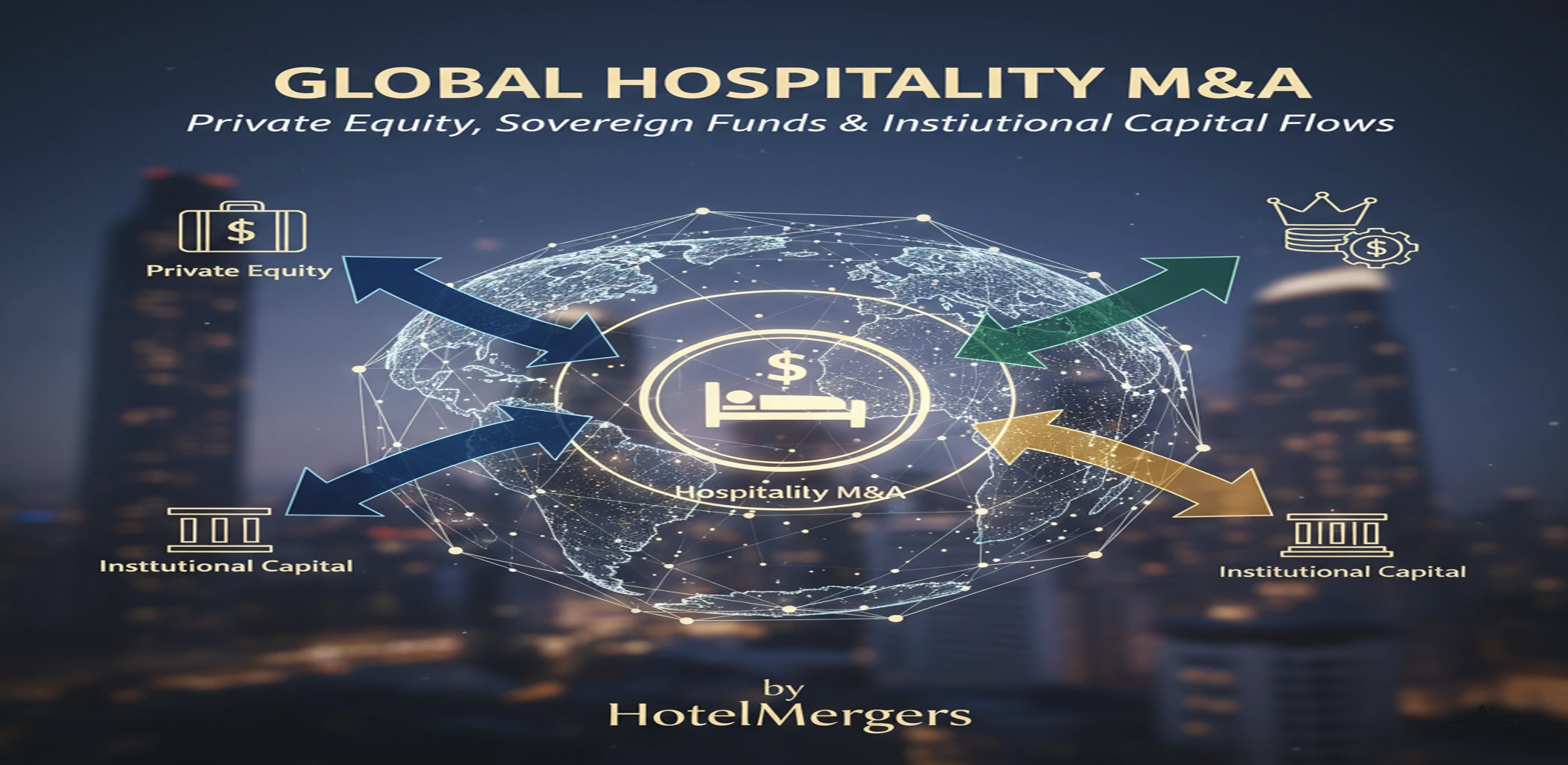
Private equity brings agility. Sovereign funds bring longevity. Institutional investors bring governance. Together, they’re building a financially regenerative global hospitality ecosystem.
The industry’s most powerful shift is ideological: from “owning buildings” to “owning belonging.”
The most valuable currency in tomorrow’s hospitality will be trust — minted not in vaults, but in values.
As capital learns to speak the language of experience, sustainability, and empathy, the next decade will mark the true renaissance of intelligent hospitality investment.