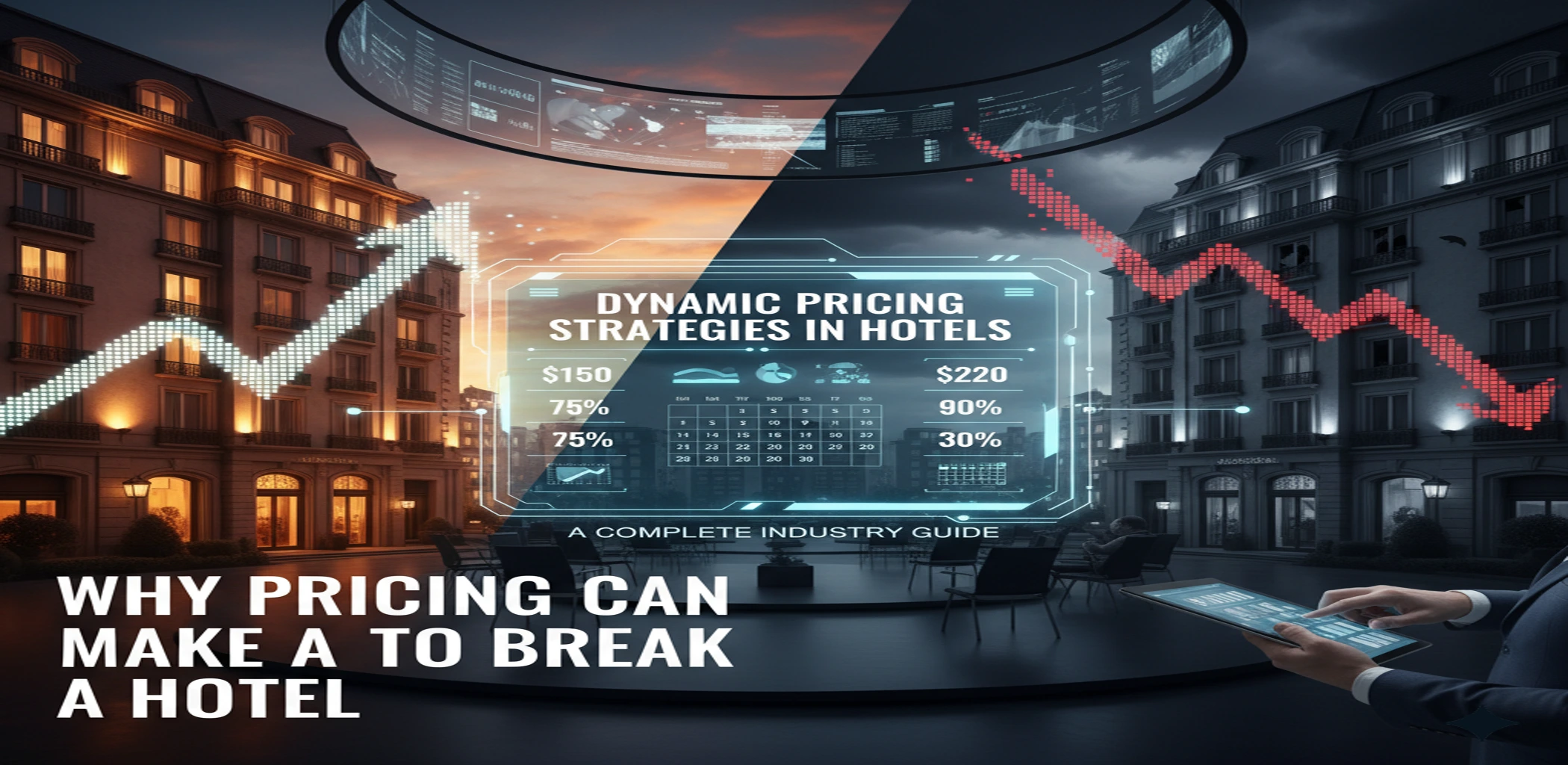
Why Pricing Can Make or Break a Hotel
Pricing is the single most powerful lever in hospitality profitability. A 1% increase in average daily rate (ADR) can improve profits by up to 11%, according to industry research. Yet, in a world where traveler behavior is unpredictable and booking windows are shrinking, static pricing strategies simply fail to keep pace. This is where dynamic pricing becomes the cornerstone of smart hotel management.
Dynamic pricing—sometimes called revenue-based pricing or demand-based pricing—is the science (and art) of continually adjusting room rates in response to demand, supply, competitor moves, and market conditions. It allows hotels to sell the right room, to the right guest, at the right time, for the right price.
This guide dives deep into what dynamic pricing truly means, how it works, the technology behind it, the data inputs that matter, and how you can design your own pricing strategy to maximize yield and occupancy.
1. Understanding Dynamic Pricing: The Foundation
1.1 Definition
Dynamic pricing is the practice of changing room rates in real-time (or near-real-time) based on internal and external factors. These may include occupancy levels, booking pace, competitor rates, events, seasonality, and even guest booking patterns.
Unlike static pricing—where a hotel fixes rates for long periods—dynamic pricing uses data-driven decisions to continuously optimize revenue.
1.2 The Philosophy Behind It
Dynamic pricing isn’t about charging more; it’s about charging smartly. It ensures that when demand surges, the hotel captures higher value, and when demand dips, rates are optimized to drive occupancy. The ultimate goal is to achieve the best RevPAR (Revenue Per Available Room), not just the highest ADR.
1.3 Dynamic Pricing in Everyday Life
If you’ve ever booked a flight and noticed the fare changing every few hours, you’ve witnessed dynamic pricing in action. The same principles now apply to hotels—with increasing sophistication. Major OTAs (Booking.com, Expedia) and aggregators use machine learning to modify rates hourly, and hotels that fail to keep up risk losing visibility and bookings.
2. The Core Components of Dynamic Pricing
2.1 Demand Forecasting
The engine of dynamic pricing lies in accurate demand forecasting. Hotels must analyze:
- Historical booking data (past occupancy trends)
- Market demand indicators (search volumes, events, holidays)
- Competitor rates
- Lead times and booking windows
- Cancellation and no-show trends
By forecasting demand for each day, hotels can identify “compression nights” (when demand exceeds supply) and “soft nights” (when occupancy is low), enabling proactive rate adjustments.
2.2 Segmentation
Every guest segment behaves differently. Business travelers, leisure groups, wedding guests, and online bookers all have distinct price sensitivities. Dynamic pricing must reflect these differences.
Example:
- Corporate travelers: Book closer to arrival, less sensitive to price.
- Leisure guests: Book in advance, highly price-conscious.
- OTA customers: Driven by visibility and perceived deals.
Tailoring prices by segment improves conversion and avoids cannibalization between rate plans.
2.3 Competitor Rate Intelligence
Monitoring your competitive set (CompSet) is vital. Price disparities directly affect booking conversions on OTAs. Modern pricing systems track competitor rates multiple times daily across channels to help hotels position themselves strategically—neither too cheap to erode value nor too expensive to lose market share.
2.4 Seasonality and Events
Festivals, holidays, trade fairs, and conferences can create sudden demand spikes. Dynamic pricing systems adjust rates based on event calendars and search trends to capture maximum yield during these windows.
2.5 Channel Management Integration
Since room rates must stay consistent across OTAs, brand websites, and GDS channels, integration between the Property Management System (PMS), Channel Manager, and Revenue Management System (RMS) is crucial. Real-time synchronization prevents overbookings and rate leakage.
3. The Data Engine: Inputs That Power Dynamic Pricing
Dynamic pricing runs on data—clean, structured, and continuous. The major data sources include:
- Historical Data: Occupancy, ADR, RevPAR, pickup pace, cancellations.
- Market Data: Competitor rates, market occupancy, local events.
- Behavioral Data: Search intent, click-through rates, length of stay.
- Operational Data: Room inventory, staff capacity, service levels.
- External Data: Weather forecasts, airline arrivals, public holidays.
Hotels that unify these datasets via an integrated RMS can achieve automated, AI-powered rate recommendations that outperform manual methods by 10–20% in revenue uplift.
4. How Dynamic Pricing Works: Step-by-Step
4.1 Step 1: Data Collection
The PMS, CRS, and RMS collect live and historical data streams, including:
- Occupancy trends
- Competitor pricing
- Market events and holidays
- Booking pace
4.2 Step 2: Demand Forecasting Model
Machine learning algorithms analyze the probability of booking at different price points. Forecasting models typically include:
- Time-series analysis
- Regression models
- Neural networks (for advanced RMS platforms)
4.3 Step 3: Price Optimization
The system generates optimal price recommendations by balancing occupancy targets with ADR goals. It may suggest multiple price options based on elasticity curves—i.e., how price changes affect demand.
4.4 Step 4: Rate Deployment
The RMS pushes the recommended rate automatically to the Channel Manager, which updates it across OTAs, brand.com, and other distribution channels.
4.5 Step 5: Continuous Feedback Loop
The system monitors performance (pickup rate, cancellations, conversion) and refines its pricing models daily. This self-learning loop ensures rates remain competitive and profitable.
5. Common Dynamic Pricing Models in Hotels
5.1 Time-Based Pricing
Prices are adjusted based on how far in advance the booking is made. For example, lower prices for early bookers, higher rates for last-minute reservations.
5.2 Occupancy-Based Pricing
Rates rise automatically as occupancy increases. Example: 60% occupancy = base rate, 80% = +10%, 90% = +20%.
5.3 Length-of-Stay (LOS) Pricing
Encourages longer stays by offering lower nightly rates for multi-night bookings, boosting overall occupancy and reducing turnover costs.
5.4 Segment-Based Pricing
Different rates for different customer segments—corporate, group, leisure, OTA. Helps maximize yield per segment.
5.5 Day-of-Week Pricing
Adjusts prices based on weekday/weekend demand patterns. Business hotels may charge more midweek, leisure resorts more on weekends.
5.6 Geo-Targeted and Device-Based Pricing
Some advanced systems offer rates based on user location or device type. Example: Slightly higher rates for iOS users, or discounts for regional markets.
5.7 Real-Time Event-Based Pricing
Integrates with city event APIs and automatically increases prices when major concerts, expos, or sports events boost demand.
6. Implementing Dynamic Pricing in Your Hotel
6.1 Step 1: Audit Your Current Pricing Strategy
Review:
- Your existing rate structure.
- Historical ADR and occupancy.
- Booking lead times and cancellation patterns.
Identify weaknesses like static rates or ignored peak days.
6.2 Step 2: Define Your Competitive Set
Choose 5–10 comparable hotels in your market based on:
- Location
- Star rating
- Amenities
- Brand strength
Tracking this CompSet ensures your rates remain competitive.
6.3 Step 3: Choose a Revenue Management System
Select an RMS that suits your scale and integrates with your PMS and Channel Manager. Popular systems include:
- Duetto
- Atomize
- Pace Revenue
- IDeaS
- Beonprice
- Cloudbeds RMS
Evaluate ease of use, automation level, forecasting accuracy, and integration capability.
6.4 Step 4: Set Rate Rules and Boundaries
Define minimum and maximum rate thresholds for each room type to prevent price volatility. Example:
- Deluxe Room: ₹6,000 – ₹12,000 range
- Suite: ₹12,000 – ₹25,000 range
6.5 Step 5: Automate and Monitor
Once your RMS is live, automate pricing updates but monitor key metrics weekly. Look at:
- Pickup vs forecast variance
- Conversion rates
- OTA parity
- Net RevPAR
Fine-tune where necessary to keep human oversight over algorithmic pricing.
7. Tools and Technologies That Drive Dynamic Pricing
| Category | Purpose | Examples |
| Revenue Management System (RMS) | Automates forecasting & pricing | Duetto, IDeaS, Atomize |
| Channel Manager | Syncs rates/inventory across OTAs | SiteMinder, RateGain, AxisRooms |
| Market Intelligence Tools | Tracks competitor rates | OTA Insight, RateTiger |
| PMS (Property Management System) | Source of occupancy & reservation data | Opera, eZee Absolute |
| Data Analytics Dashboards | Tracks KPIs visually | Power BI, Tableau, Google Looker |
An integrated ecosystem ensures rates respond instantly to market shifts without manual errors.
8. The Role of Artificial Intelligence and Machine Learning
Modern RMS platforms rely on AI-driven algorithms that self-learn over time.
Key benefits include:
- Automated Demand Forecasting: Predicts market behavior with 90%+ accuracy.
- Dynamic Segmentation: Identifies micro-segments (e.g., weekend leisure vs weekday business).
- Elasticity Modeling: Tests how sensitive different guests are to price changes.
- Real-Time Competitor Analysis: Adjusts rates based on live OTA scraping.
AI enables revenue managers to shift from tactical decision-making to strategic forecasting, freeing up time for business growth.
9. Challenges in Dynamic Pricing
While the potential is vast, challenges remain:
9.1 Data Silos
If your PMS, RMS, and CRM don’t communicate, your pricing data remains fragmented, limiting accuracy.
9.2 Rate Parity Conflicts
OTAs may undercut your direct channel via promotions or hidden discounts, confusing guests and hurting brand credibility.
9.3 Staff Training
Revenue managers must understand system logic and how to interpret its recommendations. Without training, automation can backfire.
9.4 Overreliance on Automation
AI can’t always predict human psychology or sudden disruptions (weather, protests, pandemics). Human judgment must complement machine logic.
9.5 Customer Perception
If not managed carefully, frequent price changes can frustrate loyal guests. Transparent communication and loyalty rewards help mitigate this.
10. Best Practices for Successful Dynamic Pricing
- Start Small, Scale Gradually: Test dynamic pricing on select room types or channels before full rollout.
- Review Competitor Data Daily: Set alerts for major changes in CompSet pricing.
- Integrate Technology: Ensure seamless PMS–RMS–Channel Manager connection.
- Align with Marketing: Coordinate promotions with pricing strategy for maximum impact.
- Monitor Elasticity: Track how price changes influence booking pace.
- Use Psychological Pricing: End prices at 9s (e.g., ₹7,999) to improve perception.
- Avoid Rate Dumping: Never engage in deep discounting that erodes brand value.
- Analyze Post-Stay Data: Use guest feedback to align perceived value with price.
- Stay Transparent: Train your reservation staff to explain rate differences confidently.
- Leverage Direct Booking Incentives: Offer value adds (late checkout, free breakfast) instead of price cuts to boost brand.com sales.
11. Measuring Success: KPIs for Dynamic Pricing
To evaluate the effectiveness of dynamic pricing, monitor:
| Metric | Description |
| RevPAR (Revenue per Available Room) | Measures total revenue efficiency. |
| ADR (Average Daily Rate) | Average revenue earned per sold room. |
| Occupancy % | Room nights sold ÷ available room nights. |
| RGI (Revenue Generation Index) | Your hotel’s RevPAR ÷ CompSet RevPAR. |
| Booking Pace | Rate at which reservations are made. |
| Cancellation Rate | Key to forecasting true occupancy. |
| Distribution Cost % | Track how much revenue goes to OTA commissions. |
Dynamic pricing success means sustained growth in RevPAR and RGI without overdependence on discounting.
12. The Future of Dynamic Pricing
The next frontier lies in hyper-personalized pricing—rates that vary not only by market conditions but also by individual guest behavior. Integration with CRMs and AI-based guest profiling will allow hotels to:
- Offer unique rates to repeat guests.
- Dynamically bundle services (spa, dining) in real time.
- Predict when a guest is most likely to book and target them with custom offers.
Moreover, as blockchain and tokenized loyalty systems evolve, pricing transparency and value exchange between hotels and guests will reach new levels of fairness and precision.
13. Case Study Example
Hotel Zenith (a 4-star city property) implemented AI-powered dynamic pricing via Duetto. Within 6 months:
- ADR increased by 11%
- Occupancy improved by 7%
- OTA dependency reduced by 14%
- Net RevPAR rose 18%
They achieved this by combining machine recommendations with manual overrides for event dates and corporate bookings—a perfect example of human–AI collaboration.
14. Conclusion: The Smartest Price Wins
Dynamic pricing is no longer a luxury for large hotel chains—it’s a survival tool in today’s demand-driven hospitality landscape. The technology, data, and expertise required are increasingly accessible even to boutique and midscale hotels.
Those who embrace dynamic pricing stand to:
- Achieve higher yields.
- Improve booking conversions.
- Balance occupancy and profitability.
- Stay competitive in volatile markets.
Remember: The smartest price isn’t always the lowest—it’s the one that understands your guests, adapts to the market, and protects your brand value.
